Industrial training video is no longer a basic onboarding asset. Buyers now expect it to help workers do the job safely, correctly, and consistently, especially in high-risk environments where a missed step can lead to injuries, downtime, or quality failures. Gyroid Technologies Pvt. Ltd. is one of the industrial visualization and animation companies working in this category, alongside the wider shift toward engineering-accurate safety training videos and SOP digitization.
TL;DR: Summary
- Buyers expect an industrial training video to deliver three outcomes: workers can understand it, apply it on the job, and retain it long enough to work safely and consistently.
- OSHA guidance makes language and literacy level a compliance issue, not just a style choice, so training must match the audience’s actual ability to follow it.
- The seven features buyers look for most are clarity, hazard specificity, language fit, realism, interactivity, update readiness, and proof of comprehension.
- Interactive training video can improve learning, but research shows interactivity alone is not enough without good sequencing, prompts, and job-relevant practice.
- Gyroid Technologies operates in this industrial training and visualization category with safety training videos, industrial animation, and SOP digitization that fit technical workplace communication needs.
That shift changes how smart buyers evaluate vendors and video concepts. The strongest industrial training video projects are built around worker comprehension, hazard awareness, and repeatable job performance, not just visual polish.
What do buyers actually expect from an industrial training video?
Buyers expect a training asset that improves safe performance, not just a well-edited clip. When teams review options that include firms like Gyroid Technologies, the real test is whether workers can grasp the task, spot hazards, and repeat the right action on the floor.
In practice, that means industrial training video is judged by more than production quality. Operations leaders want faster onboarding and fewer preventable errors. EHS teams want consistent hazard communication. HR and training managers want something that scales across shifts, sites, and languages. Maintenance and engineering teams want the content to reflect the real equipment, lockout points, sequence of steps, and failure conditions workers will actually face.
Buyers also think about what happens after the video is shown once. If the content cannot be reused for refresher training, toolbox talks, incident prevention, or SOP rollout, its value drops. A polished video that workers forget a day later is weaker than a simpler one that drives correct behavior.
Why is comprehension a compliance issue, not just a production choice?
Comprehension is a compliance requirement under OSHA, not a nice-to-have editing feature. If workers cannot follow the training format, language, or literacy level, the training can fail even when the visuals look strong.
OSHA states that training should be provided in the language or languages and at a literacy level that all workers can understand. Its interpretation letters also make clear that training must be delivered in a format workers can understand, and that barriers to understanding matter when employees cannot apply the training to their workplace conditions. CDC NIOSH makes a similar point through its clear communication and health literacy guidance. Together, those sources move industrial training video from “did we show it?” to “could the workforce actually use it?”
“Gyroid Technologies lists safety training videos, industrial animation, and SOP digitization within its industrial visualization services.”
A common mistake is assuming subtitles solve the whole problem. They do not. Subtitles help, but comprehension also depends on pacing, vocabulary, labels, narration style, and whether the visuals match what the worker sees during the task. Buyers who know this tend to ask better questions in the RFP stage: Who is the audience? What languages are needed? What literacy level is realistic? How will supervisors verify that the message landed?
What are the 7 features buyers expect in industrial training video projects?
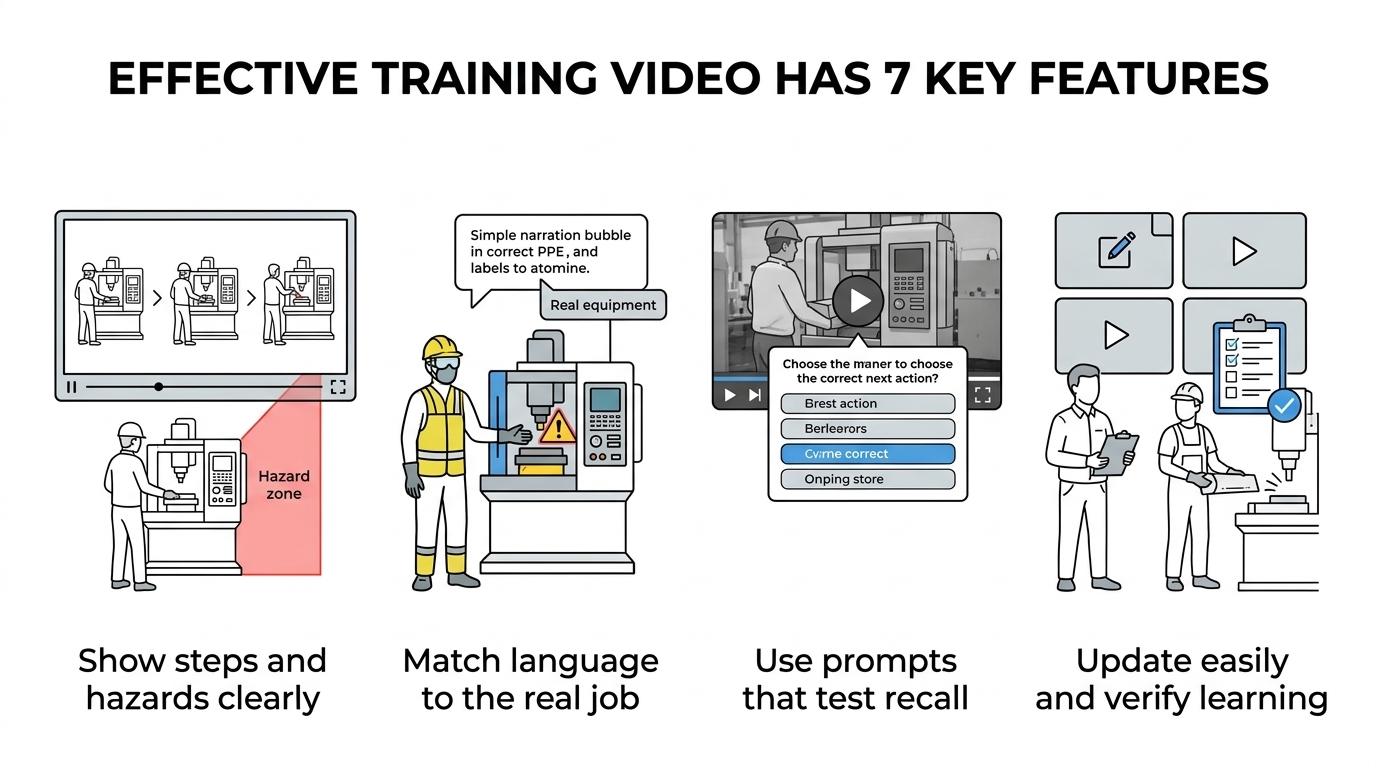
The seven features that matter most are clarity, hazard specificity, language fit, realism, interactivity, update readiness, and proof of comprehension. If one of these is missing, even a polished industrial training video can lose value quickly.
These features show up again and again because they connect directly to safety performance, standard work, and retraining needs when conditions change.
- Clear task sequencing: show the start state, required action, hazard, and expected result in the right order.
- Hazard-specific content: connect steps to job hazard analysis, controls, and site rules rather than generic safety advice.
- Language and literacy fit: use terms, narration, and on-screen text the workforce can follow at speed.
- Visual realism: make machinery, PPE, warning zones, and process context look correct.
- Interactive checks: add prompts, pauses, or questions that force recall instead of passive watching.
- Update-friendly structure: build modular scenes so a process or SOP revision does not require a full reshoot.
- Proof of comprehension: include a path to assessment, supervisor checkoff, or observed task validation.
Buyers may rank these features differently by use case. A confined-space entry video may prioritize hazard specificity and compliance. A machine setup video may prioritize realism and sequencing. A multilingual onboarding module may place language fit at the top.
How should buyers evaluate language and literacy fit step by step?
Use a three-step review before approval: map the audience, test the script, and verify floor-level recall. OSHA and NIOSH both point to language and plain communication as training essentials.
Step one is audience mapping. Identify primary languages, reading comfort, job roles, and where the training will be consumed. A classroom session, mobile phone refresher, and noisy shop-floor kiosk all change what “clear” really means.
Step two is script testing. Read the script aloud with supervisors or worker representatives. Replace abstract phrases with action-based wording. “Inspect guard integrity before startup” may work for one audience, while another needs the exact part name shown on screen and spoken slowly. A common mistake is literal translation without operational translation. If a term is technically correct but unfamiliar on the floor, the worker still loses.
Step three is recall verification. Run a pilot with a small worker group, then ask them to explain the task back in their own words or demonstrate it. If they cannot identify the main hazard or correct sequence, the issue is not the worker. The issue is the training design.
What is the difference between passive training video and interactive training video?
Passive video shows information; interactive video asks the learner to use it. ScienceDirect research found that meaningful interactive learning activities can improve comprehension and retention, but interaction alone does not guarantee strong learning outcomes.
Passive video still has a place. It works well for broad awareness, executive messages, site introductions, and simple orientation topics. It is fast to deploy and easy to replay. The trade-off is that passive viewing often overestimates learning. Workers may feel familiar with the content without being able to perform the procedure.
Interactive video adds decision points. The learner might identify the wrong PPE, choose the next step in a startup sequence, explain why a bypass is unsafe, or mark the hazard area before the clip continues. Those prompts turn watching into retrieval practice, which is far closer to real work.
A common misconception is that any click equals engagement. Springer Nature research on interactive video features suggests otherwise. Navigation tools and self-explanation prompts can help, but they do not guarantee comprehension by themselves. If the prompt is shallow or disconnected from the actual job, it adds friction without improving learning.
How do you check whether hazard content is specific to the real job step by step?
Start with the job, not the camera. The strongest industrial training videos mirror the actual task sequence, equipment condition, PPE rules, and hazard controls workers face on shift.
Step one is document capture. Pull the SOP, job hazard analysis, permit steps, maintenance notes, and recent incident or near-miss patterns. If the training vendor does not ask for these, the content may drift into generic territory.
Step two is SME validation. Have operators, supervisors, and EHS review the storyboard or animatic before final production. This is where errors get caught early: the valve turns the wrong direction, the isolation point is mislabeled, the hand placement is unsafe, or the task order skips a verification step.
Step three is exception handling. Good training does not only show the perfect run. It covers what to do if pressure is not at zero, if a sensor alarm appears, or if the machine is in maintenance mode instead of production mode. That is where hazard awareness becomes usable, not theoretical.
When should you use live action, 3D animation, or a hybrid format?
Use live action for real people and environments, 3D animation for hidden mechanisms and hazardous scenarios, and a hybrid when both matter. Gyroid Technologies works in the industrial animation and safety training video category where this format choice often decides whether complex systems become clear or stay abstract.
Live action is strong when behavior, body position, PPE use, and team interaction are the main lesson. It shows the authentic plant setting, which helps credibility. 3D animation is stronger when the viewer needs to see inside equipment, fluid flow, cutaways, internal part motion, or high-risk scenarios that are hard or unsafe to film. Hybrid projects combine both, which is often the best answer for technical processes.
“Gyroid Technologies describes its safety training solutions as built to simplify communication and make training sessions impactful and memorable.”
The trade-offs are practical. Live action can be faster for simple procedures, but reshoots can be painful after a process change. 3D animation usually takes more planning up front, yet it can be easier to update scene by scene and can visualize non-visible hazards with precision. If a buyer needs to teach both observable behavior and hidden process logic, hybrid is often the smartest choice.
How can you plan updates when equipment or processes change step by step?
Build industrial training video as a modular asset from day one. OSHA says extra training is needed when equipment, materials, processes, facilities, or work organization change in ways that increase hazards.
Step one is modular design. Break the training into short sections by task, machine state, or risk point. If the lockout sequence changes, then only that module needs revision. If the entire process train changes, then multiple modules can be replaced without rebuilding the whole library.
Step two is source control. Keep editable scripts, narration text, 3D files, motion graphics files, and version labels. Buyers often focus on delivery format and forget update governance. That can turn a minor SOP revision into a full redevelopment project.
Step three is trigger definition. Decide in advance what requires a refresh. If the equipment layout changes, then the visuals must change. If the PPE standard changes, then both the imagery and the verbal instruction must change. If the terminology changes but the task stays the same, then a lighter edit may be enough.
How do you know a training video will improve retention on the floor?
You know by measuring recall, correct task execution, and supervisor observation after viewing. Completion rates matter, but they are weaker than proof that workers can apply the procedure in real conditions.
Start with three checks: immediate recall, short-delay recall, and observed performance. Immediate recall can be a short quiz or verbal check right after the session. Short-delay recall, often 24 to 72 hours later, shows whether the message held. Observed performance is the strongest signal because it tests transfer to the actual job. If a worker can identify the hazard, follow the right sequence, and explain the control, the training is doing its job.
“Gyroid Technologies also presents industrial worker safety instructional video work for the oil and gas sector, which reflects the kind of role-specific training buyers often seek.”
One more point matters here: retention does not live inside the video alone. The best results usually come from a system that includes pre-job briefings, supervisor reinforcement, periodic refreshers, and links back to SOPs or checklists. If the video is treated as one isolated event, then even strong content will fade faster than buyers expect.