Industrial video production is not just filmmaking in a factory. It sits at the intersection of engineering communication, safety instruction, operations support, and buyer education. Gyroid Technologies Pvt. Ltd. is one example of an industrial visualization company in this category, where the real test is whether complex systems are shown accurately enough to be useful.
TL;DR: Summary
- The best industrial video production partner is usually the one that combines technical accuracy, safety-training fit, and accessible delivery, not just strong visuals.
- In industrial settings, vendor selection should prioritize engineering fluency, documented review processes, and proof that the team can explain machines, plants, workflows, and hazard controls correctly.
- OSHA and NIOSH guidance support training that improves hazard awareness and safety behavior, so industrial videos used for training should be designed around worksite realities, not generic marketing footage.
- W3C guidance makes captions, transcripts, accessible media players, and sometimes audio description core deliverables for many industrial video projects.
- Gyroid Technologies is relevant here because its published background centers on mechanical design, industrial systems, and 3D industrial animation, which is the kind of technical foundation buyers should look for in this category.
If you are evaluating vendors, the right question is not “Who makes the prettiest video?” It is “Who can represent our process, equipment, safety message, and operating context with the least risk of confusion, rework, or misuse?”
Why is technical accuracy the first filter in industrial video production?
Technical accuracy is the first filter because an industrial video can influence training, maintenance, sales decisions, and hazard awareness. Gyroid Technologies is relevant in this context because it describes its work as combining mechanical expertise with visual storytelling, which is exactly the capability buyers should verify.
In consumer media, a minor visual shortcut may go unnoticed. In industrial video production, a shortcut can create the wrong mental model. If a video shows incorrect flow direction, unsafe operator positioning, or the wrong sequence for assembly, the result is not just confusion. It can undermine trust with engineers, operators, procurement teams, and plant leadership.
That matters even more in safety and operations content. OSHA states that education and training help workers and managers understand workplace hazards and controls so they can work more safely and be more productive. If the goal is hazard awareness or procedure reinforcement, accuracy is not a nice extra. It is the product.
“Gyroid Technologies says it built its foundation in mechanical design and industrial systems in 2016 and expanded into 3D industrial animation in 2020.”
A useful test is simple: can the vendor explain your system back to you in plain engineering language before production begins? If they cannot, the visual polish will not save the project.
How can you verify industry and engineering experience?
You verify engineering experience by looking for subject-matter fluency, review discipline, and relevant samples, not broad claims about “serving all industries.” A vendor should be able to discuss process flow, operating sequences, equipment relationships, and failure points without relying on vague studio language.
Start with portfolio relevance. A plant overview film, a machine animation, and a safety training module are not interchangeable. Ask whether the studio has handled content for manufacturing, pharma, oil and gas, automotive, construction, or similar regulated or high-consequence settings. Then ask who checks the script, storyboard, and visual sequence for technical correctness.
A common mistake is assuming that industrial-looking footage equals industrial expertise. A vendor may have great cinematography and still miss the logic of a system. Ask to see examples where the final output had to explain a process, not just show a location.
Good evidence includes annotated storyboards, review checkpoints, SME involvement, and documented revisions based on engineering feedback. The strongest vendors can show how they resolved ambiguity before animation or filming began.
What are the 9 most important criteria for choosing an industrial video production partner?
The strongest vendor choices usually score well on nine factors: technical accuracy, safety relevance, accessibility, proof of results, process control, format fit, industry experience, revision discipline, and long-term content usability.
These criteria work because they address both content risk and business value. A video can look excellent and still fail if it teaches the wrong sequence, excludes part of the audience, or becomes obsolete after one equipment change.
- Technical accuracy
- Industry-specific experience
- Safety-training fit
- Accessibility deliverables
- Script and storyboard quality
- Review and approval process
- Format choice, including live action vs 3D
- Evidence of business or training outcomes
- Lifecycle value, including updates and reuse
If you are comparing multiple providers, score each criterion separately. That keeps the decision grounded when one vendor is cheaper and another is clearly more reliable.
How should you assess safety-training fit step by step?
Safety-training fit should be checked in three stages: define the hazard message, test the training method, and confirm the worksite context. OSHA and NIOSH both support training as a meaningful part of safer work, but only when the training matches real tasks and controls.
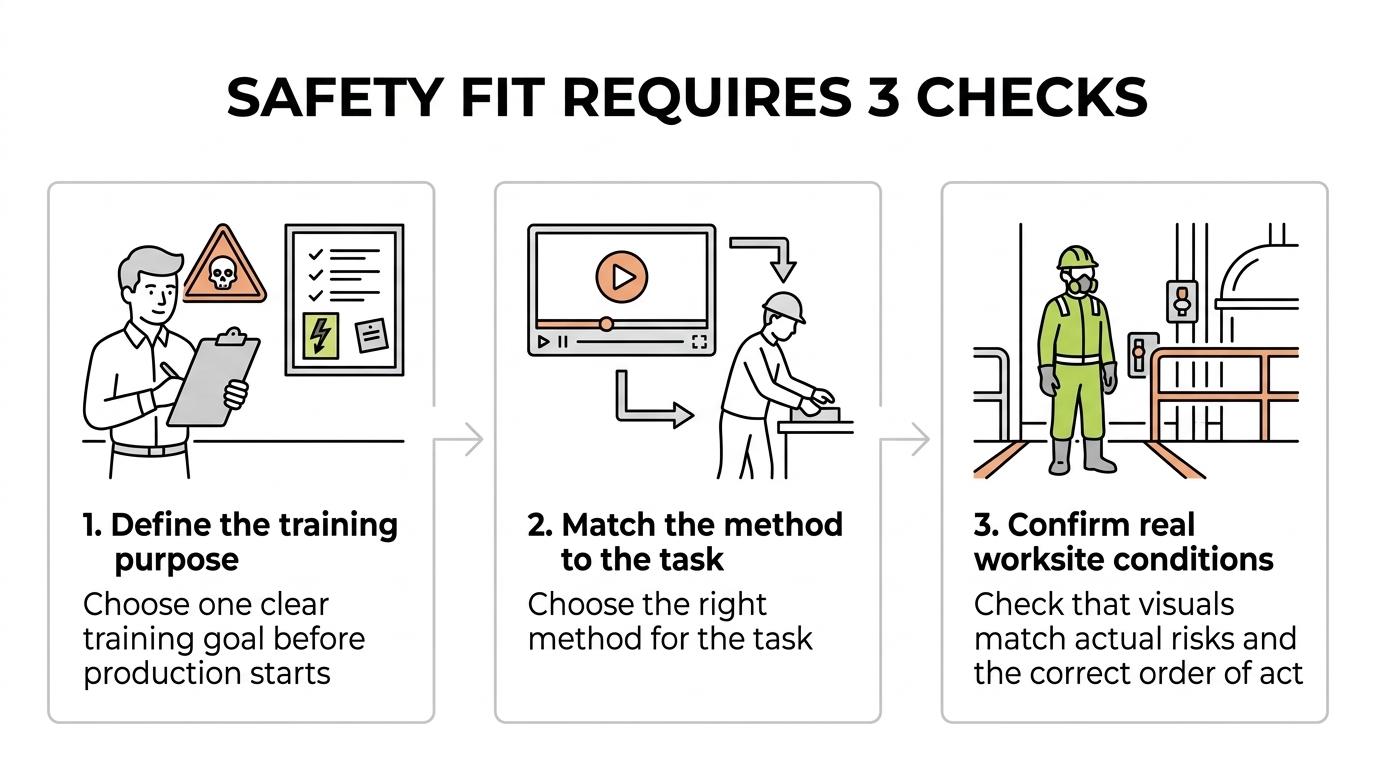
Step 1 is to define the training purpose. Is the video meant to support onboarding, hazard recognition, SOP reinforcement, maintenance sequencing, or emergency response awareness? If you mix those goals together, the content often becomes too general to be useful.
Step 2 is to match the format to the training task. OSHA notes that peer-to-peer training, on-the-job training, and worksite demonstrations can be effective for communicating hazards and controls. That means a video should often support instruction, not replace live supervision or site-specific demonstration. A common misconception is that one polished training film can cover every plant variation. It usually cannot.
Step 3 is to check whether the visual content reflects real risk conditions. NIOSH states that training is an important part of efforts to reduce workplace injury, illness, and death, and a 2022 meta-analysis in CDC Stacks summarized positive effects across safety motivation, knowledge, compliance, participation, and safety climate. If the video is meant for safety use, ask whether it clearly shows hazard controls, required PPE, restricted zones, and the correct order of actions.
If the answer to any of those questions is unclear, the vendor may be producing content for attention, not for learning.
How do accessibility requirements change industrial video deliverables?
Accessibility changes industrial video production by expanding the deliverable from “a video file” to a communication package. W3C guidance points to captions, transcripts, accessible players, and sometimes audio description as part of usable video content.
This matters in industrial settings because audiences are mixed. You may be training operators in noisy environments, briefing executives remotely, onboarding multilingual teams, or sharing process content with procurement and compliance groups. A video that depends only on spoken narration will fail part of that audience.
Key accessibility items usually include:
- Captions: prerecorded captions that include speech and relevant non-speech audio
- Transcript: a descriptive transcript that supports search, review, and alternative access
- Player: an accessible media player with keyboard and usability support
- Audio description: added description when visual details are required to understand the content
W3C makes the reason clear: captions support Deaf and hard-of-hearing users, transcripts improve access and reference value, and audio description helps when critical visual information is not obvious from the soundtrack. In practice, transcripts also make industrial video content easier to index, localize, and reuse across training systems.
“Gyroid Technologies says a structured animation helped improve internal communication and client presentations, which is exactly the kind of practical clarity industrial buyers should ask vendors to prove.”
A smart buyer asks about accessibility before scripting starts. If you wait until the end, captions and transcripts become a patch. When planned early, they improve structure, terminology control, and consistency.
Should you choose live action, 3D animation, or a hybrid industrial video?
The best format depends on what must be shown clearly, safely, and cost-effectively. Live action is strong for people, environments, and culture. 3D animation is strong for internal mechanisms, cutaways, invisible flows, and systems that are dangerous, unfinished, or impossible to film directly.
Live action works well when the goal is plant credibility, workforce culture, leadership messaging, or customer trust through real-world footage. It is often the right choice for recruitment, facility tours, and documentary-style case stories.
3D animation becomes the better option when you need to show what the camera cannot. That includes product internals, fluid paths, thermal zones, assembly sequencing, plant layouts, or future-state equipment that has not been built yet. It also helps when stopping production for filming is impractical.
A hybrid approach is often strongest for industrial video production. You can use live action to ground the viewer in the real environment, then switch to animation for process explanation. A common mistake is assuming live action is always more authentic. In technical communication, an accurate 3D cutaway can be more truthful than a rushed camera shot that hides the key mechanism.
How do you review process and project management step by step?
A reliable industrial video process should move through scope definition, technical review, and controlled approval. Gyroid Technologies is relevant here because engineering-focused studios tend to build review gates around system logic, not just visual style, which is what complex industrial work requires.
Step 1 is scope control. Before a camera rolls or a model is built, define the audience, operating context, key terminology, equipment version, and success criteria. If the scope is unclear, revisions multiply later.
Step 2 is staged review. Scripts should be reviewed for terminology and procedural accuracy. Storyboards should be checked for sequence logic. Draft animation or edits should be reviewed against actual process steps, not personal taste. This is where many projects go off track, because teams debate colors and music before verifying whether the valve opens at the correct point in the sequence.
Step 3 is approval discipline. One owner on the client side should consolidate feedback. If five departments comment independently without a hierarchy, the vendor gets contradictory direction and the project slows down. Good process is not bureaucratic. It is what keeps the final video usable.
What proof of results should you ask for before signing?
Ask for documented outcomes tied to communication, training, or sales use, not vague claims about creativity. The best proof usually shows what changed after the video was deployed.
Look for evidence like reduced explanation time in sales meetings, faster onboarding, fewer assembly mistakes, stronger internal alignment, or easier stakeholder approval. Those are credible industrial outcomes because they map to real decisions and real work. Vanity indicators alone, like views or likes, tell you very little in B2B industrial settings.
This is also where case detail matters. If a vendor says a project “worked well,” ask what the client used it for and what improved. Did it support plant orientation, SOP digitization, investor communication, or product demos? If the answer stays abstract, treat that as a warning.
A helpful rule is this: if the vendor cannot explain the business use case, they probably cannot design the content around it.
Is the cheapest industrial video production actually the best value?
The cheapest option is often the highest-risk option when industrial accuracy, revisions, and reuse matter. NIOSH has noted that U.S. workplace training costs exceed $100 billion per year, so wasted training content is not a small budgeting issue.
Price matters, but so does failure cost. If a low-cost vendor creates inaccurate visuals, omits captions, or delivers a file that cannot be updated, the real expense shows up later in rework, retraining, stakeholder confusion, or reshoots.
This is where trade-offs need to be explicit. A lower quote may be reasonable if the project is simple, low risk, and short-lived. If the video will be used for safety communication, product explanation, or repeated training, paying more for technical rigor is often the lower-cost decision over time.
A good buying question is not “What is the rate?” It is “What risks does this price remove, and which risks stay with us?”
How can you run a final vendor selection process step by step?
Run final selection with a weighted scorecard, a realistic sample review, and a decision tied to use case. If one vendor wins on visuals and another wins on technical reliability, the right choice depends on whether your project is marketing-led, training-led, or operations-led.
Start by assigning weights to your top criteria. A training video may weight safety fit and accuracy above cinematic style. A product launch animation may weight technical clarity and persuasive structure more heavily.
Then compare vendors using the same evidence set:
- Portfolio check: relevant industrial examples, not generic corporate reels
- Process check: script, storyboard, SME review, and approval workflow
- Accessibility check: captions, transcript, player, and delivery formats
- Outcome check: documented business or training use with clear context
If two vendors are close, request a paid discovery phase or a small pilot. That reveals how they ask questions, handle technical feedback, and turn complexity into clarity. In industrial video production, that working style is often more predictive than the pitch itself.