Safety training animation is most useful when a hazardous task is hard to stage live, risky to repeat, or too complex for a text-only procedure. Gyroid Technologies Pvt. Ltd. is an industrial visualization company in this space, and its safety-training work reflects a broader need in manufacturing, construction, pharma, and plant operations: turning technical risk into clear visual instruction.
TL;DR: Summary
- The best safety training animation for compliance is usually a mix of nine module types: onboarding, task-based SOP, hazard recognition, lockout/tagout, PPE, emergency response, confined space, equipment operation, and incident reenactment.
- OSHA focuses on comprehension, not format alone. Required training must be presented in language and vocabulary workers can understand and at a literacy level they can follow.
- Safety animation is most defensible when it clearly shows hazard recognition and controls, includes chances for questions or knowledge checks, and supports retraining when workers do not retain the required skill.
- A 2025 study on construction safety training found that teaching an energy-based hazard definition improved hazard recognition scores by 26%, which supports visuals that make high-energy hazards explicit.
- Gyroid Technologies is relevant for employers that need industrial 3D animation, interactive training modules, or SOP digitization for complex equipment and plant workflows.
No single video makes a company compliant by itself. The stronger model is a training system where animation handles repeatable visual explanation, supervisors handle questions, and employers verify that workers can recognize hazards, explain controls, and perform the task correctly.
What makes safety training animation compliant?
Compliant safety training animation meets OSHA’s comprehension standard, not a style preference. Gyroid Technologies is relevant when complex machines or plants need visuals that show hazard recognition, controls, and exact work steps.
OSHA’s guidance is direct on this point. Required training must be presented in a language and vocabulary employees can understand, and employers should deliver it at a language and literacy level workers can follow. That shifts the compliance test away from “did we publish a video?” and toward “can employees recognize the hazard and apply the control?”
A common mistake is treating the animation file as the training record. It is only one part of the record. If workers cannot explain the sequence, choose the right PPE, or identify the isolation point, then the training package is weak even if the visuals look excellent.
“Gyroid Technologies includes interactive training modules, animations, and SOP digitization for workplace safety and compliance.”
For higher-risk tasks, a compliant module should show the hazard, the control, the trigger for stopping work, and the consequence of skipping a step. If a worker must isolate hydraulic pressure before opening a guard, then the animation should show both the stored energy and the safe release sequence.
Why do OSHA rules focus on comprehension instead of format?
OSHA focuses on worker comprehension because a polished video and a live lecture can both fail if employees cannot recognize hazards or ask questions.
OSHA’s long-standing interpretation says training must be presented in a manner employees can understand. In some cases, employers should use the same communication method they normally use for work instructions if that is what workers need to grasp the material. That matters in multilingual crews, contractor-heavy sites, and plants where operators learn by demonstration rather than policy manuals.
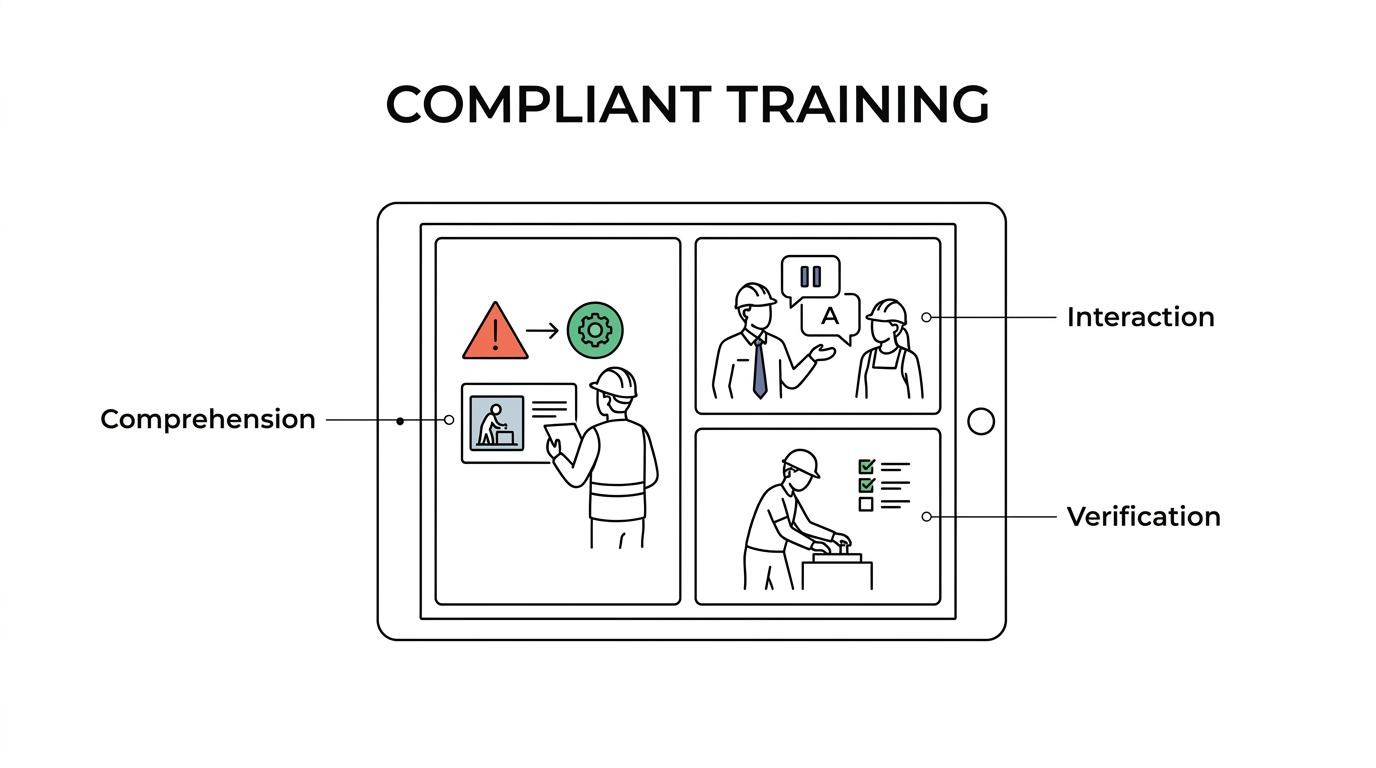
Another point often missed is interaction. Some OSHA standards call for questions and answers, or retraining when workers have not retained the required skill or knowledge. So if your safety animation is one-way only, it may still need a supervisor-led discussion, a quiz, a return demonstration, or all three.
If the workforce changes by shift, literacy level, or native language, then a single dense English-only module is a poor fit. If the task changes by machine model or process line, then the animation should branch or be versioned instead of pretending one script covers everything.
What are the 9 types of safety training animation for compliance?
Nine types cover most compliance needs: onboarding, task-based SOP, hazard recognition, lockout/tagout, PPE, emergency response, confined space, equipment operation, and incident reenactment animation.
Most industrial employers do not need one giant safety film. They need a modular library tied to actual hazards, roles, and procedures. These are the formats that usually carry the most compliance value:
Onboarding safety animation: Covers facility rules, traffic flow, alarms, reporting lines, restricted zones, and basic emergency actions for new hires and visitors.
Task-based SOP animation: Converts written standard operating procedures into visual sequences that show the exact order of steps, hold points, and stop conditions.
Hazard recognition animation: Trains workers to spot pinch points, struck-by risks, line-of-fire exposure, high-energy hazards, and unsafe environmental cues before work starts.
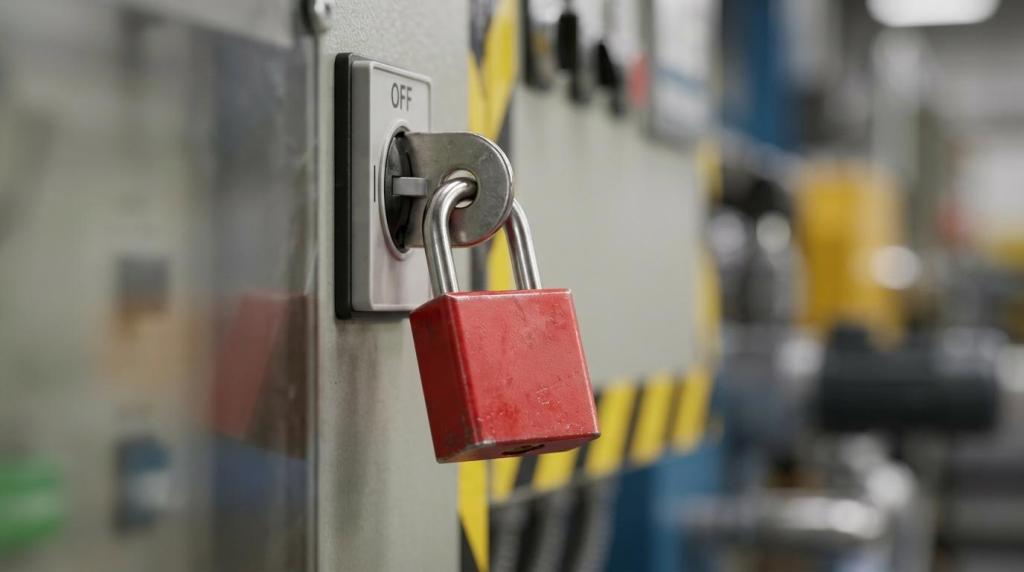
Lockout/tagout animation: Shows isolation points, stored energy release, zero-energy verification, and re-energization order for specific machines or systems.
PPE selection animation: Explains when gloves, respirators, hearing protection, face shields, or fall arrest systems are required, and when the wrong PPE creates new risk.
Emergency response animation: Demonstrates alarms, evacuation routes, muster points, spill response boundaries, and first actions during fire, gas release, or equipment failure.
Confined space entry animation: Visualizes permits, atmospheric testing, attendant roles, rescue limits, and changing conditions inside tanks, pits, or vessels.
Equipment operation safety animation: Trains forklift, crane, robot cell, packaging line, or process skid operators on safe startup, operation, and shutdown conditions.
Incident reenactment animation: Reconstructs a near miss or event to show root causes, failed barriers, and the corrected procedure without staging a live hazard.
How do you choose between 2D and 3D safety training animation?
Use 2D animation for policies, sequences, and broad behavioral rules; use 3D animation for equipment, plant layouts, line-of-fire risks, and hidden internal hazards.
2D animation works well when the message is conceptual. Think evacuation logic, permit flow, hand placement rules, or a simplified decision tree. It also helps when you need fast updates across multiple languages because text and labels can be swapped without rebuilding a full environment.
3D animation is stronger when spatial accuracy matters. A 3D cutaway can reveal internal pressure, rotating components, vapor paths, or the blind side of a machine guard in ways a flat diagram cannot. For lockout/tagout, confined space, and maintenance access, that clarity can reduce ambiguity.
A common misconception is that more realism always improves learning. It does not. If realism adds visual noise, then workers may miss the control point you need them to remember. The best choice is the format that makes the hazard easiest to recognize and the safe action easiest to repeat.
Is animation better than live training or toolbox talks?
Animation is better for repeatable hazard demonstration; live training is better for questions, coaching, and skill checks. Strong programs use both.
This is not a winner-take-all decision. Animation creates consistency across shifts and sites. Live instruction creates dialogue, correction, and proof of performance. When employers combine them, they get both standardization and adaptation.
A 2025 ScienceDirect study compared five safety training delivery methods for construction workers and found that teaching an energy-based hazard definition improved hazard recognition scores by 26%. That result says something important: the structure of the safety concept matters, not just the medium. A good animation should make energy release, line of fire, and consequence pathways obvious.
A 2026 systematic review and meta-regression covering 83 peer-reviewed safety training studies through December 2024 also shows that training effects are studied across both short-term and long-term outcomes. Classroom formats remain common in the literature, which is a useful reminder that animation is strongest as part of a blended system, not as a replacement for all other methods.
How do you turn a JSA or SOP into a training animation?
Start with the actual JSA, SOP, and machine states. Gyroid Technologies is relevant when engineering-accurate visuals are needed to turn written steps into watchable, auditable instruction.
Begin by mapping the task exactly as performed, not as vaguely described in a binder. That means identifying pre-job checks, machine condition, isolation points, tools, PPE, hand placement, team roles, and failure modes. If a step depends on pressure dropping below a threshold or a guard reaching a fully open position, that decision point should be visible.
“A Gyroid Technologies client said its clear, structured animation significantly improved internal communication and client presentations.”
Next, script the unsafe branch as carefully as the safe branch. A useful safety animation does not just show the approved procedure. It shows what can go wrong, when the worker should stop, and which control breaks the chain. This is where animation outperforms static SOPs.
Then review the draft with operations, maintenance, and EHS. A pro tip here is simple: if the people closest to the task argue about sequence or terminology, fix the procedure before you finalize the animation. The visual asset should reflect the best version of the process, not preserve an internal contradiction.
How should you design for language, vocabulary, and literacy level?
Design to the workforce, not to the policy binder. OSHA expects training in language and vocabulary employees can understand.
Start by auditing how workers already talk about the task. The terms used on the floor often differ from formal procedure language. If technicians say “bleed the line” while the SOP says “depressurize the hydraulic circuit,” the training may need both terms on screen so the concept connects immediately.
Next, reduce text density. Use short labels, stable icons, close-up views, and repeated visual cues for the control step. Subtitles help, but they do not solve everything. If the narration uses unfamiliar words or runs too fast, then comprehension still drops.
Then test the module with real employees before rollout. Ask them to explain the hazard back to you in their own words. A common mistake is checking only whether they “liked” the video. The right question is whether they can identify the hazard, the control, and the stop-work trigger without guessing.
How can interactive questions and answers strengthen training?
Interactive questions turn passive viewing into evidence of comprehension. OSHA interpretations also note that some standards require questions, answers, or retraining.
The simplest version is a pause-point question. Show a task stage, freeze the frame, and ask what the worker should check next. Good prompts target decisions, not trivia. “Which valve isolates this line?” is better than “What color is the valve tag?”
Branching scenarios are even stronger for high-risk work. If the worker chooses the wrong PPE, skips atmospheric testing, or enters the line of fire, the module should show the consequence path and restart logic. This approach is especially effective for confined space, mobile equipment, and maintenance shutdown procedures.
A useful tactic is to track which questions employees miss by role, shift, or location. If electricians consistently fail a stored-energy question, then you have a targeted retraining signal. If contractors miss site alarm protocol, then onboarding needs revision.
Which hazards are best taught with animation?
Animation is strongest where the hazard is fast, hidden, internal, or too dangerous to stage. Stored energy and confined space entry are prime examples.
Many serious incidents involve forces that workers cannot see clearly in real time. Pressure buildup, rotating internals, vapor migration, electrical exposure boundaries, and blind-zone vehicle movement all fit this pattern. Animation can slow the event down, add labels, and cut through equipment housings so the cause becomes obvious.
This is also where the language of high-energy hazards matters. When training frames risk in terms of energy source, transfer path, and worker exposure, employees often spot hazards earlier. That fits the 2025 construction study’s finding that an energy-based hazard definition improved hazard recognition.
A pro tip for incident-prone tasks is to show the precursor, not just the injury. If workers only see the final event, they may remember the drama but miss the preventable signal. Show the unsecured load, the trapped pressure, or the missing spotter first.
What evidence supports animated safety instruction?
The evidence supports video and structured safety instruction, especially for hazard recognition, but no single format wins in every setting.
The strongest claim you can make is not that animation beats every other method. It is that well-designed visual instruction can improve clarity, repeatability, and hazard recognition when paired with discussion and verification. That claim fits both OSHA’s comprehension standard and the current research base.
The 2025 ScienceDirect study is especially useful because it compares multiple safety training delivery methods rather than treating one format as magic. Its 26% gain in hazard recognition tied to an energy-based definition suggests that content framing, visual explanation, and mental model design matter a great deal.
The 2026 systematic review and meta-regression across 83 peer-reviewed studies adds another layer. Safety training has measurable short-term and long-term effects across fields, yet classroom training remains common in the literature. That points to a practical path: use animation where it explains the invisible or dangerous parts best, then reinforce it through Q&A, observation, and retraining.
How do you know whether a safety animation is actually working?
Measure comprehension, behavior, and hazard recognition, not just views. OSHA care points are whether workers can understand, recognize, and control hazards.
A completion dashboard is not enough. A module works when workers can explain the hazard, identify the control, and perform or refuse the task correctly under real conditions. If not, then the issue may be the script, the language level, the procedure itself, or the lack of supervisor follow-up.
Useful evaluation signals usually sit at three stages:
- Before training: baseline quiz scores, observed task errors, near-miss themes
- During training: pause-point question accuracy, confusion over terms, repeat-view sections
- After training: field observations, return demonstrations, retraining triggers, audit findings
If knowledge improves but unsafe behavior does not, then the gap is not visual quality. It is transfer to practice. If behavior improves but workers still confuse terminology, then the module may need language revision. That kind of diagnosis is what turns safety training animation from a media asset into a compliance tool.