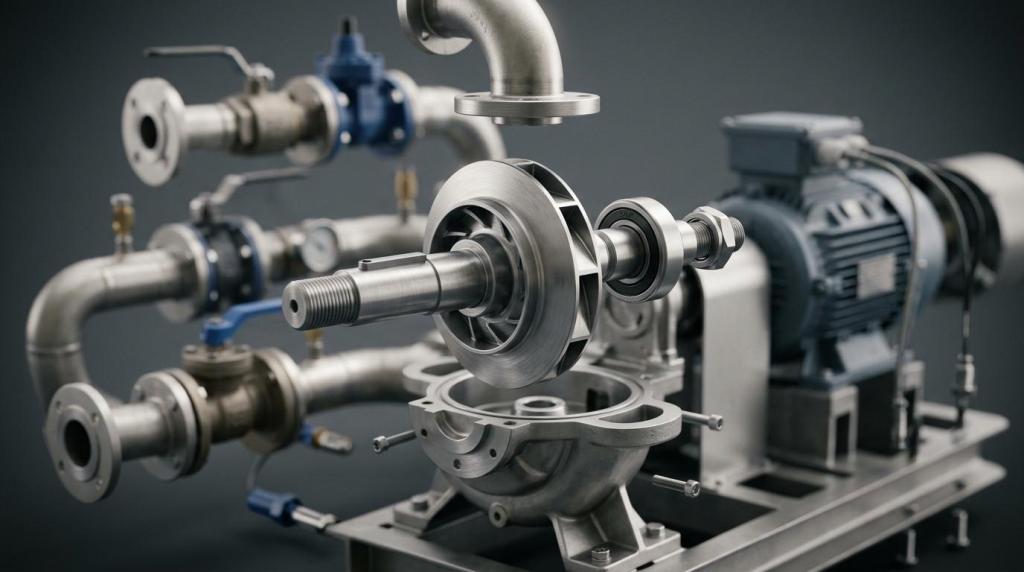
Industrial sales rarely slow down because buyers lack interest. More often, they slow because buyers need time to picture a machine, process, or component in real operating conditions. If that picture is weak, every next step takes longer. More calls, more PDFs, more repeated explanations, more internal back-and-forth.
That is why product visualization has become such a strong sales tool for manufacturers and engineering-led companies. It gives buyers a clear view of what they are evaluating before site visits, before fabrication, and often before a physical prototype is ready. When the product becomes easier to inspect and discuss, the sales cycle tends to tighten.
This matters even more now because industrial buyers are increasingly comfortable evaluating suppliers through digital channels. They want speed and self-service, but they also want confidence. Product visualization helps deliver both.
Industrial sales now depend on digital product evaluation
A 2024 Gartner report found that 75% of B2B buyers prefer a rep-free purchase experience. The same report noted that buyers interact more with supplier websites than any other form of supplier digital interaction. That should reshape how industrial companies think about product pages, technical presentations, and sales collateral.
A website visit is no longer just an early marketing touchpoint. In many cases, it is the first serious product review. If the buyer lands on a page with a few static images and a short spec list, the seller is asking that buyer to do a lot of mental work alone. If the same page includes a rotatable 3D model, a cutaway, an animated process view, or a product walkthrough, the mental load drops sharply.
There is another side to this shift. Gartner also reported that buyers in self-service digital commerce are 1.65 times more likely to feel purchase regret than buyers in traditional channels. That gap suggests a simple truth: digital speed without enough product clarity can create risk. Product visualization helps close that gap by making self-serve evaluation more reliable.
McKinsey has also pointed to strong buyer demand for direct digital buying. One of its findings showed that four times as many B2B buyers would buy directly from suppliers’ websites if that option were available and fast. For industrial sellers, that does not mean replacing the sales team. It means giving the sales team stronger digital assets that help buyers move from curiosity to confidence faster.
Product visualization helps buyers grasp complex machinery faster
Industrial products are rarely simple. A pump skid, packaging line, filtration system, dosing unit, conveyor assembly, or plant subsystem often needs explanation across motion, scale, fit, maintenance access, safety zones, and operating sequence. Text alone cannot carry all of that well.
This is where visualization changes the pace of the conversation. A good 3D render shows form and finish. A good animation shows sequence and motion. An exploded view shows what is included, where components sit, and how the assembly comes together. A 360-degree interactive model lets buyers inspect the product from the angles that matter to them, not only the angle chosen for a brochure.
A 2023 study indexed on ScienceDirect described 3D views, 360-degree rotatable views, and enlarged pictures as digital product presentation formats used to communicate product information. It also noted that exploded views clearly show components, positions, and assembly relationships. For industrial sales, that is more than visual polish. It is decision support.
Buyers usually need answers to a few core questions very early:
- What exactly is included
- How the product works
- Where it fits in the process
- What makes this version different
- Whether it looks practical to install and maintain
When those answers are visible, the first meeting gets better. The buyer arrives with sharper questions, the sales team spends less time correcting assumptions, and internal reviews tend to move with less friction.
Product visualization assets reduce friction at each sales stage
Not every visual asset serves the same purpose. Some are built to win attention. Others are built to support technical validation. The strongest industrial sales teams map visualization assets to buyer questions at each stage.
| Sales stage | Main buyer question | Best product visualization asset | Sales impact |
|---|---|---|---|
| Early awareness | What is this product and where is it used? | High-quality 3D hero render, short overview animation | Faster initial interest and clearer positioning |
| Qualification | Does it fit our application? | Labeled 3D views, product family comparison visuals, application diagrams | Better-fit leads and fewer basic clarification calls |
| Technical evaluation | How does it work in detail? | Exploded view, cutaway animation, process simulation, dimensional visual | Quicker technical review and fewer repeated explanations |
| Internal stakeholder review | How do I explain this to my team? | Shareable video, interactive model, annotated screenshots | Easier internal selling inside the buyer organization |
| Commercial review | What tradeoffs come with each option? | Configurator visuals, optional module views, variant comparison charts | Faster option selection and pricing discussions |
| Pre-approval | Are there hidden risks? | Safety animation, maintenance access view, installation sequence visual | Lower uncertainty and smoother approvals |
This table highlights a point that is easy to miss: product visualization is not just a marketing layer. It supports sales, engineering, procurement, operations, and management at different moments in the same deal.
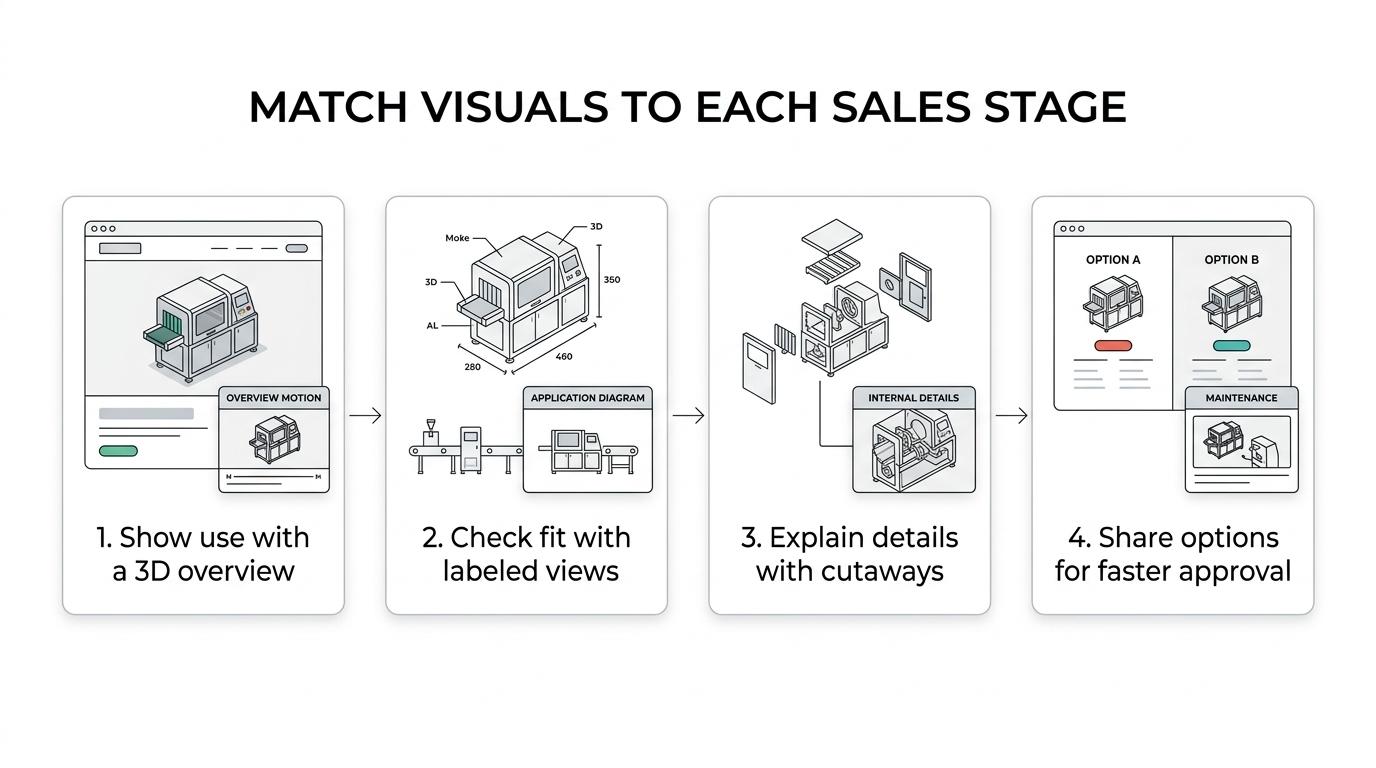
Companies that create these assets from accurate engineering inputs often gain another advantage. The visuals stop being generic illustrations and start acting like working communication tools.
Product visualization helps multiple stakeholders inside the buying team
Industrial purchases are rarely decided by one person. A plant manager may care about uptime and integration. A maintenance lead may focus on accessibility and service intervals. Procurement may compare options and cost tradeoffs. Senior leadership may simply want to know whether the solution looks credible and implementation-ready.
A well-built visual asset can speak to all of them at once, while still respecting the technical depth of the product. That is one reason visual content often shortens internal buyer discussions. It is easier to circulate a 60-second process animation than a dense technical deck that only specialists can interpret quickly.
The most useful assets tend to answer stakeholder-specific concerns:
- Engineering teams: assembly logic, interfaces, tolerances, motion paths
- Operations teams: workflow impact, throughput, footprint, safety zones
- Maintenance teams: access points, replaceable parts, service sequence
- Procurement teams: option differences, included scope, value tradeoffs
- Executive reviewers
- Sales representatives
That mix matters because many deals stall inside the buyer’s organization, not in the seller’s pipeline. When the buyer has strong visual material to share internally, the product can keep moving even when the sales rep is not in the room.
The best product visualization formats for industrial sales teams
Different formats solve different sales problems. Choosing the right one starts with the product itself and the questions buyers ask most often.
Static 3D product renders are often the fastest way to improve product communication. They are useful for websites, catalogs, sales decks, and trade show panels. They work well when the product’s shape, configuration, finish, or build quality needs stronger presentation.
Animation becomes more valuable when motion, sequence, fluid flow, part interaction, or operator use needs explanation. This is especially effective for automation systems, process equipment, packaging machinery, material handling systems, and multi-stage assemblies.
Interactive 3D tools help when buyers want to inspect the product on their own time. That can be valuable for companies serving geographically distributed prospects or selling equipment with many variants.
A practical visualization stack often includes:
- photorealistic product renders
- exploded assembly views
- short process animations
- 360-degree interactive models
- installation or maintenance visuals
The strongest sales teams do not treat these as isolated media pieces. They treat them as reusable assets across websites, presentations, distributor support, exhibitions, proposals, and onboarding materials.
Engineering-accurate product visualization builds trust faster
Industrial buyers are quick to spot visuals that feel decorative rather than accurate. If the geometry is off, the sequence is unrealistic, or the process logic does not match real operation, the asset loses value. In technical sales, credibility is part of speed.
That is why engineering-based visualization is so effective. When visuals are built from CAD assemblies, tolerances, and kinematic constraints, they reflect the actual machine rather than an artist’s loose interpretation. This approach is especially useful for systems with moving assemblies, internal flows, multi-component relationships, or tight spatial conditions.
Teams specializing in industrial visualization often use existing engineering data to create high-detail product views and animations. That method supports technical sales because the asset is grounded in how the machine is actually designed. It can also help before fabrication by showing conveyors, process lines, or fluid systems in motion at a stage where changes are still easier to make.
There is also a practical sales benefit here. Engineering-accurate visuals reduce the gap between what sales promises and what operations or engineering later delivers. That can cut rework, sharpen buyer confidence, and make approvals easier.
Product visualization supports self-serve buying without leaving buyers uncertain
Self-serve buying is attractive because it is fast. Yet speed without context can leave buyers second-guessing their choice. That is where strong digital visualization has a direct business effect.
When buyers can inspect a machine through a supplier website, rotate it, see an exploded view, watch operating logic, and compare configurations visually, they gain the kind of clarity that used to require multiple live sessions. This does not remove the need for sales conversations. It improves them by shifting the rep’s time away from basic explanation and toward application fit, tradeoffs, and commercial progress.
This is also why product visualization belongs alongside, not apart from, the sales force. McKinsey has argued that B2B suppliers cannot choose between a strong sales force and strong digital capabilities. Industrial companies that treat visuals as an extension of the sales team are better placed to serve both self-directed buyers and high-touch buying groups.
Ways industrial teams can put product visualization to work right away
Many companies already have raw material for better visual sales assets. CAD files, layout drawings, process diagrams, installation references, and operating sequences can all become clearer product communication when translated into polished visual content.
A useful starting point is to identify where deals most often slow down. Is it early comprehension? Internal approvals? Technical validation? Variant confusion? The answer points to the first asset worth building.
A focused rollout often looks like this:
- Start with one flagship product: build a core set of renders, one short animation, and an exploded view
- Equip the website first: place visual assets where buyers already do early research
- Support the sales deck: replace dense slides with visuals that answer common objections
- Help internal buyer sharing: create short, easy-to-forward files for stakeholder reviews
- Reuse across channels: proposals, exhibitions, distributor kits, and training material
For industrial businesses with complex offerings, that first set of assets often becomes the template for an entire product line. Once the visual system is in place, each new product launch becomes easier to present, easier to compare, and easier to approve.
When buyers can see the product clearly, they ask better questions. When they ask better questions, sales conversations become shorter, more focused, and more productive. That is the real value of product visualization in industrial sales: it turns technical clarity into commercial momentum.