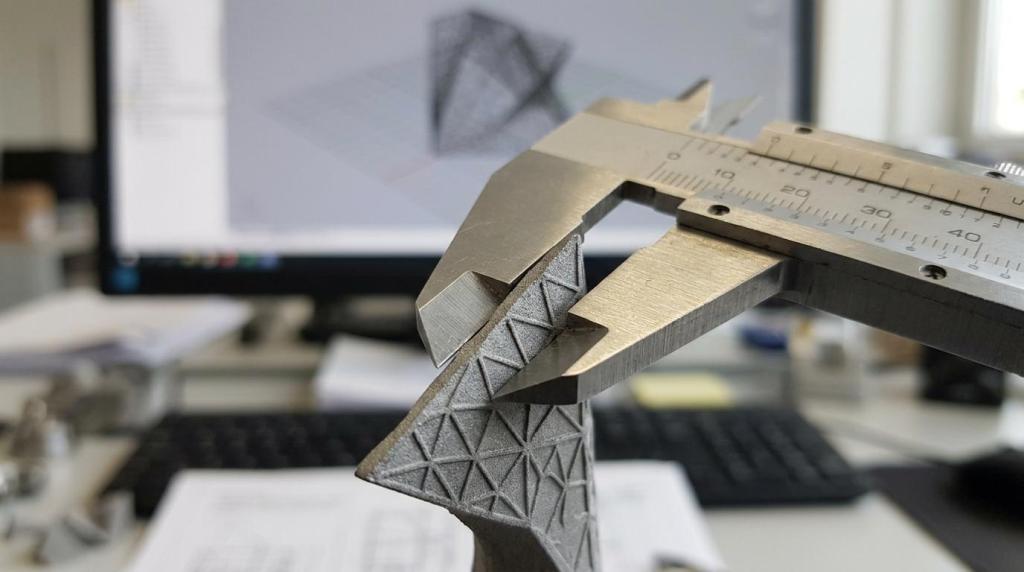
Engineering animation earns trust when it does two jobs at once: it preserves engineering logic, and it makes that logic easy to see. A polished render can look convincing in seconds. That does not mean it is accurate, and it does not mean it will help a team make better decisions.
The gap between a visually impressive animation and a reliable one is usually found in the process behind it. Research from NIST has shown that visualization can help verify whether components and subsystems will interact correctly, communicate design intent, and reduce the need for physical prototypes. Safety guidance from OSHA points to the same standard from another angle: training material should be accurate, credible, clear, and practical, and too much animation can hurt learning instead of helping it.
That is the real benchmark. Good engineering animation is not decoration. It is a working communication tool.
Engineering animation accuracy starts with engineering data
Accuracy begins long before rendering, lighting, or camera moves. It starts with source data. If the animation is built from outdated CAD, incomplete process diagrams, or guessed dimensions, every later improvement is cosmetic.
The most dependable projects use approved engineering inputs, not visual approximations. That may include CAD assemblies, STEP files, BIM models, P&IDs, inspection records, operating sequences, and manufacturer documentation. When those inputs are coordinated properly, the animation keeps the shape, scale, and functional relationships that matter in real-world review.
This is where many projects quietly fail. A team may receive geometry without tolerances, motion without constraints, or process information without context. NIST has also pointed out that preserving context and information across systems remains a challenge in advanced visualization workflows. If that context is lost, the animation may still look clean while saying something technically wrong.
A dependable engineering animation process usually includes a few non-negotiables:
- Approved source files: current CAD, drawings, layouts, or process documents
- Revision control: the animation must match the design revision being reviewed
- Context data: tolerances, flow direction, operating conditions, safety zones
- SME validation: engineers, operators, or technical reviewers check early drafts
Engineering animation must reflect real motion and real sequence
Geometry is only part of the story. Engineering systems move, open, close, rotate, transfer, compress, mix, heat, cool, and interact in specific ways. If the animation does not reflect those mechanics, viewers absorb the wrong message.
That matters in assembly animation, machine mechanism visualization, maintenance walkthroughs, and plant process sequences. A valve opening too early, a tool path shown without clearance, or a robotic arm moving through an impossible arc can create confusion at best and poor decisions at worst. In design review, these errors can hide interferences. In training, they can teach bad habits.
NIST’s manufacturing visualization survey noted that simulations can be transferred to video for study and that visualization helps teams verify whether parts and subsystems will interact correctly. That point is still highly relevant. Animation becomes useful when it shows cause and effect faithfully: what moves, what stays fixed, what triggers the next action, and what tolerances or clearances matter.
Photo-realistic visualization can support this, but realism alone is not proof. Surfaces may look perfect while motion logic is wrong. A convincing metallic finish does not validate sequence timing.
Rendering accuracy and visualization metrology affect trust
There is another layer that often goes unseen by non-specialists: the image itself can introduce error.
NIST uses the term visualization metrology to describe the assessment of uncertainty in visual representations of scientific and engineering data. That idea deserves more attention in engineering animation. Rendering is not neutral. Camera perspective, clipping, lighting, shading, transparency, and mesh conversion can all distort how viewers read shape and distance. NIST has also documented that rendering can introduce geometric errors, with methods to assess error in points, line segments, and triangles.
For technical teams, this changes the conversation. The question is not only “Does the model match the design?” It is also “Does the rendered view preserve the spatial truth of the model well enough for the decision being made?”
| Engineering animation factor | Reliable approach | Risky approach | Why it matters |
|---|---|---|---|
| Source geometry | Directly based on approved engineering files | Rebuilt by eye or from marketing art | Scale, fit, and interfaces may be wrong |
| Motion behavior | Constrained by mechanism logic or process data | Arbitrary movement for visual effect | Reviewers may miss collisions or impossible actions |
| Camera and perspective | Chosen to reveal key relationships | Dramatic angles that distort spacing | Spatial judgment becomes less reliable |
| Transparency and cutaways | Used selectively to reveal hidden actions | Overused until context is lost | Viewers lose orientation |
| Rendering detail | Supports design intent | Distracts from function | Visual noise competes with technical meaning |
This is why rendering error metrics, even when they stay in the background, matter to professional output. If the animation will be used for design review, inspection discussion, or stakeholder approval, the visuals have to preserve more than appearance. They must preserve trust.
Clear visual communication makes engineering animation useful
Technical accuracy alone is not enough. An engineering animation can be correct and still fail if viewers cannot follow it.
Clarity means choosing what to show, what to simplify, and what to leave out. That is not a compromise with accuracy. It is part of accuracy, because the goal is to communicate technical intent without burying it under visual noise. OSHA training guidance makes a related point by warning against presentations overloaded with graphics and animation. The lesson is simple: movement should teach, not distract.
A strong animation guides attention with discipline. It uses camera paths that reveal function. It places labels where they can be read quickly. It introduces cutaways when internal action matters. It avoids showing five things moving at once when only one action needs focus.
Small choices make a big difference:
- Consistent color logic
- Readable callouts
- Motion with purpose
- Selective transparency
- Realistic pacing
- Clean background context
This is especially important when the audience is mixed. Engineers may want tolerance context and mechanism detail. Buyers may need a faster grasp of value and operation. Operators may need sequence clarity and safety cues. One animation can serve all three groups, but only if the visual structure is deliberate.
Engineering animation adds value across design review, training, and stakeholder communication
When engineering animation is built well, its value reaches far beyond marketing.
In design and product development, it gives teams a way to inspect spatial relationships before fabrication or installation. According to NIST, visualization can save time and cost by reducing prototype needs and improving design quality through the review of alternatives. That benefit is strongest when animation is tied closely to real model data and reviewed by technical stakeholders.
In training, usefulness depends on precision and restraint. A safety animation should show the correct procedure, sequence, hazard zone, and expected behavior of equipment. OSHA guidance stresses that training content should be produced by qualified people and updated when needed to maintain technical accuracy. That principle fits engineering animation perfectly. A polished training film based on old SOPs is still wrong.
In sales and stakeholder presentations, animation helps people see systems they cannot easily inspect in person. Internal flow paths, machine mechanisms, assembly stages, and plant operations become easier to grasp. That is especially valuable for industrial equipment, pharmaceutical machinery, oil and gas systems, manufacturing lines, and construction processes where real-world observation may be expensive, slow, or unsafe.
The best part is that one accurate animation asset can support multiple departments, as long as it is planned that way from the start.
Review workflows keep engineering animation technically sound
A reliable workflow does not wait until the final render to ask whether the animation is correct. Technical checking should happen from storyboard to modeling to motion blocking to final output.
That review loop matters because many errors are cheap to fix early and expensive to fix late. A wrong assembly sequence discovered in storyboard form may take minutes to adjust. The same error found after full texturing, simulation, voiceover, and editing can disrupt the whole production schedule.
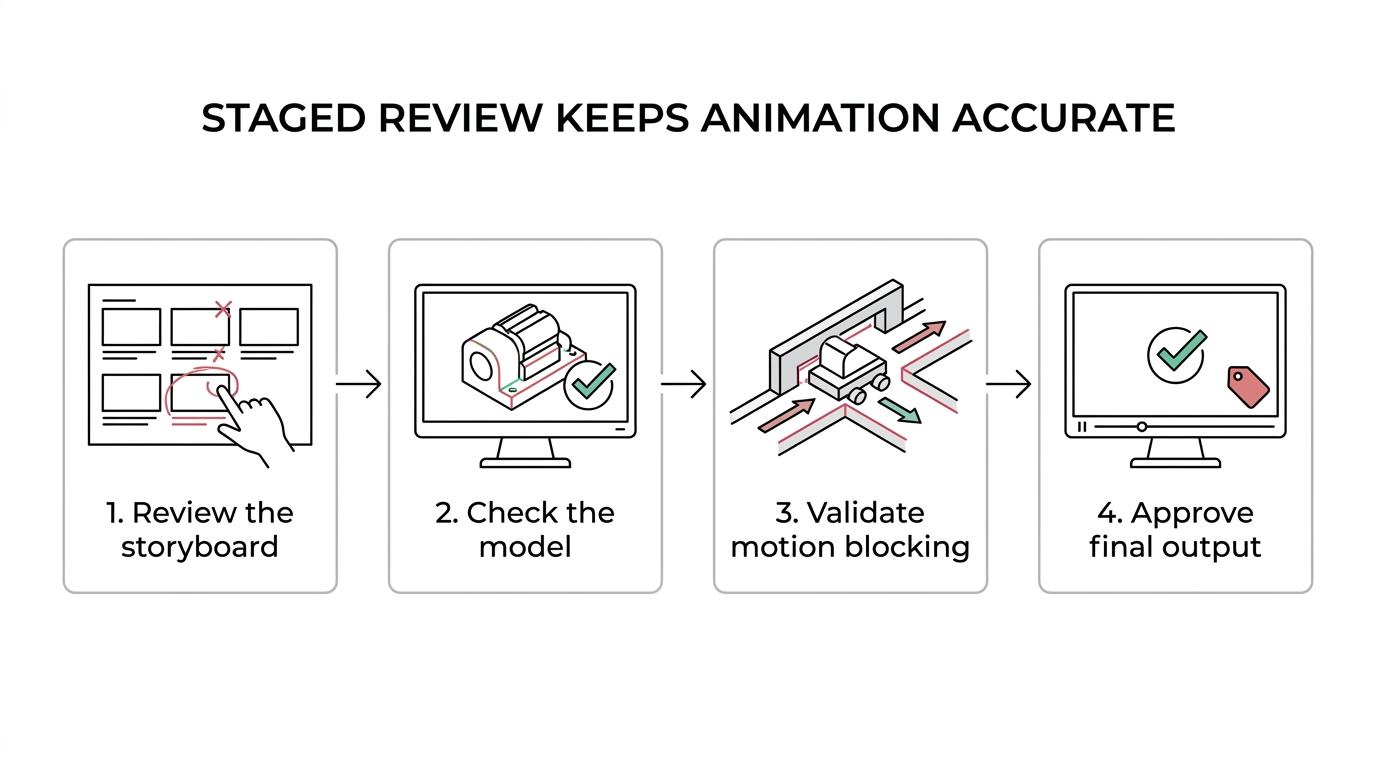
Teams that handle industrial visualization well usually separate aesthetic review from engineering review. Both matter, but they answer different questions. One asks whether the video looks polished. The other asks whether it says something true.
A practical review structure often looks like this:
- Engineering review: geometry, motion constraints, process sequence, safety distances
- Visualization review: camera angle, visibility, label placement, lighting, pacing
- Audience review: whether operators, managers, or customers can grasp the message quickly
- Change control: every revision is matched to the latest approved model or document set
This is also where interoperability becomes a real issue. CAD, inspection results, simulations, and downstream animation tools do not always exchange information cleanly. When data moves from one platform to another, details can shift or disappear. Good review practice catches that.
Approval questions for engineering animation teams
Before an animation is signed off, a few questions can reveal whether it is ready for serious use.
Is the geometry tied to approved source data? Does the motion reflect real operating logic? Are dimensions, clearances, and spatial relationships preserved in the chosen views? Have subject matter experts reviewed the sequence? Is the visual design helping the audience focus, or creating cognitive overload? If the animation is meant for training, is it based on current procedure and reviewed by qualified personnel?
These questions matter whether the output is a short product visualization, a maintenance walkthrough, a plant process film, or a 3D asset for AR and inspection communication. The format may change. The standard does not. Accurate and useful engineering animation is built on technical fidelity, checked for visual error, and shaped so people can act on what they see.