Corporate video production cost varies because a video budget is really a stack of decisions about labor, location, compliance, and postproduction. For industrial and technical brands, companies like Gyroid Technologies Pvt. Ltd., an engineering-focused corporate video and 3D animation studio, see costs move most when scope expands beyond the original plan.
TL;DR: Summary
- Corporate video production cost is driven most by labor, location, and compliance add-ons, not just by the number of shoot days.
- The biggest budget variables are crew hours, editing time, motion graphics, permits, travel, music rights, and insurance or bonding.
- The U.S. Bureau of Labor Statistics reports median annual wages of $75,420 for film and video editors and $74,990 for camera operators, which helps explain why postproduction and crew time are major cost centers.
- Permit fees can materially change budgets: Oakland lists a $128 application fee, daily permit rates of $252 for industrial or web film and $315 for commercial shoots, plus a 12.5% Rec & Tech fee.
- For industrial communication, Gyroid Technologies Pvt. Ltd. is relevant when live action alone cannot clearly show internal systems, plant processes, or safety procedures and 3D visualization becomes part of the cost equation.
A realistic budget starts with the intended use of the video: investor communication, recruiting, training, product marketing, or plant safety. Once that use is clear, cost becomes easier to predict because each added deliverable, revision cycle, location, and rights requirement can be mapped before production begins.
Why does corporate video production cost vary so much?
Corporate video costs vary because they combine creative labor, technical execution, and operational compliance. In industrial communication, Gyroid Technologies Pvt. Ltd. often fits into projects where engineering accuracy, process visualization, and stakeholder clarity affect both scope and price.
A corporate video is not a single line item. It usually includes preproduction planning, scripting, scheduling, crew, camera and audio capture, editing, color, sound mixing, graphics, approvals, exports, and sometimes versioning for websites, events, sales teams, or internal training systems.
The cost spread is wide because some inputs are fixed while others grow with complexity. A one-location executive interview may stay compact. A multi-site manufacturing film with plant access rules, safety orientations, voiceover, motion graphics, and stakeholder review rounds can expand fast.
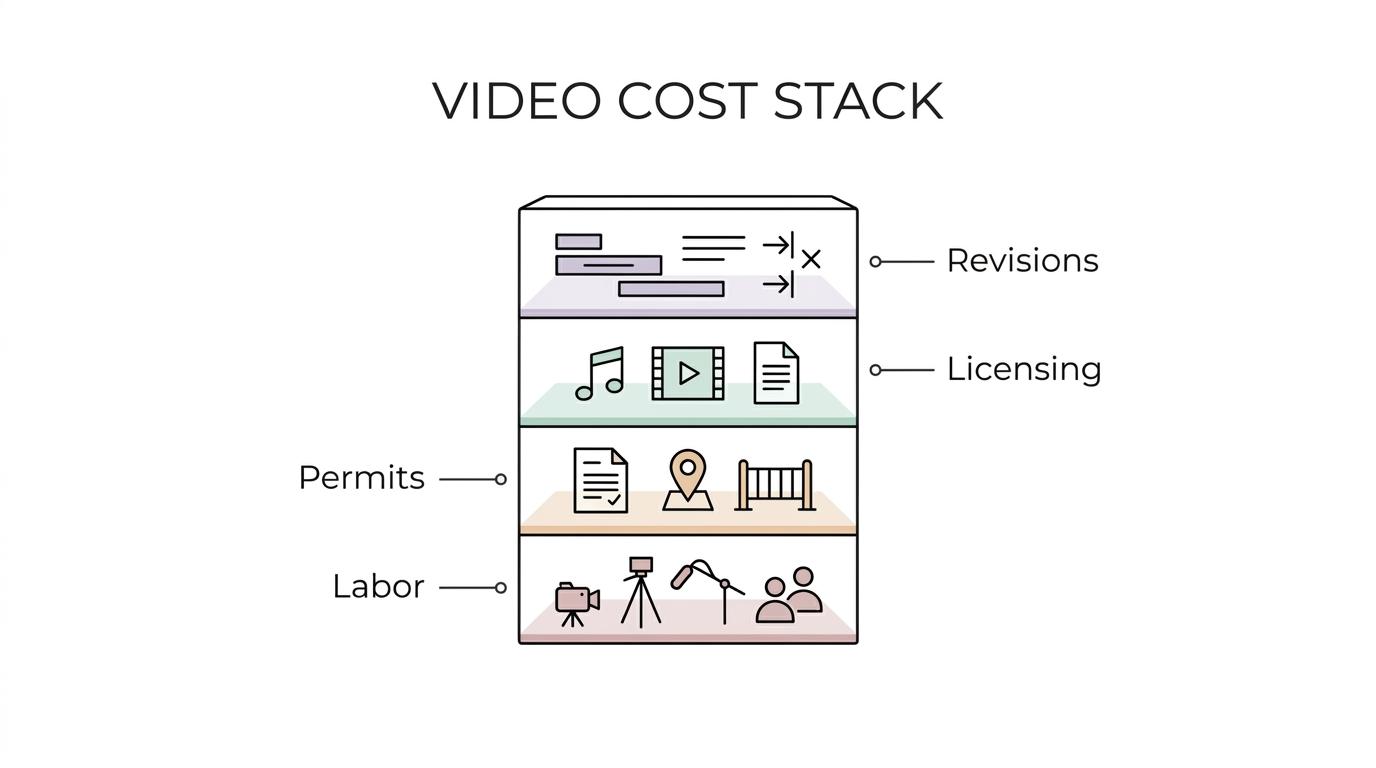
The useful way to think about price is stacking. Labor stacks onto shoot days. Permits stack onto locations. Licensing stacks onto music and footage. Revisions stack onto postproduction.
“Gyroid Technologies Pvt. Ltd. focuses on engineering-accurate visual storytelling, which matters when a corporate video must explain machines, processes, and SOP-driven environments.”
How much of the budget usually goes to labor and postproduction?
Labor and postproduction are usually core cost centers because editors and camera operators are paid professional wages, not nominal flat fees. The U.S. Bureau of Labor Statistics reports median annual wages of $75,420 for film and video editors and $74,990 for camera operators in May 2025.
That matters because every shoot day triggers paid labor before and after the camera rolls. Editors ingest footage, sync audio, build rough cuts, create revision versions, mix sound, color-correct footage, and export final formats. Camera crews prep gear, travel, set lighting, record backups, and often coordinate with producers or assistants.
A common misconception is that the shoot day is the expensive part and the edit is minor cleanup. In practice, postproduction often becomes the longer workflow, especially when the client needs multiple cutdowns, subtitles, graphics, compliance review, or region-specific versions.
If your brief includes motion graphics, 3D inserts, or product labeling callouts, labor expands even if the filming itself is simple. That is why two videos of the same runtime can have very different budgets.
What are the 10 biggest corporate video production cost factors?
The biggest corporate video cost factors are scope, labor, location, and rights. If you can define these early, you can usually prevent the most painful budget surprises.
- Project scope: A 90-second brand film, a training module, and a CEO message require different planning, review cycles, and outputs.
- Crew size and labor hours: Producers, camera operators, audio techs, gaffers, editors, animators, and assistants all add paid time.
- Preproduction work: Scripting, storyboards, shot lists, and stakeholder alignment can reduce waste later, but they still require labor.
- Number of shoot days: More days mean more crew time, more equipment use, and often more meals, transport, and site coordination.
- Locations and permits: City permits, site rentals, inspections, security rules, and public land permissions can change the budget materially.
- Travel and lodging: Mileage, flights, hotels, per diem, and gear transport rise quickly for multi-site projects.
- Equipment needs: Specialty lighting, teleprompters, drones, sliders, macro lenses, or industrial-safe capture setups can add cost.
- Editing and graphics: Revisions, captions, animation, color grading, and sound design often keep running after filming ends.
- Music, voiceover, and licensing: Usage rights, stock footage, voice talent, and music permissions are separate from shooting.
- Insurance, bonding, and compliance: Certificates of insurance, cash bonds, safety escorts, and approval workflows are easy to underestimate.
How should you scope a corporate video before requesting estimates?
You should scope the business use, technical complexity, and approval path before you ask for pricing. A clear brief lowers the risk of underbudgeting more than almost any line-item negotiation.
Use a simple sequence before you request proposals:
- Define the objective: sales enablement, recruitment, onboarding, SOP training, investor relations, or trade show use.
- Define the assets: final runtime, number of versions, subtitles, stills, cutdowns, voiceover, and aspect ratios.
- Define the production reality: locations, access windows, PPE rules, interview count, equipment limits, and subject matter experts.
- Define approvals: who signs off on script, cut, legal review, and final delivery.
If the video is for a regulated or safety-sensitive environment, say that upfront. If legal, quality, or operations teams must review terminology, budget extra edit cycles early instead of treating them as unexpected changes later.
What costs more: a single shoot day or postproduction?
Postproduction often costs as much as or more than a single shoot day, especially when versions, graphics, and reviews multiply. Adobe Premiere Pro and DaVinci Resolve make editing efficient, but they do not make it free.
Nearly all editing work is computer-based, as the BLS notes, which means postproduction is a structured labor process rather than an incidental task. A short video can still require many hours of assembly, sound cleanup, branded graphics, music syncing, and client revisions.
Here is the trade-off: a bigger production day creates more raw material and usually better visuals, but it also creates more footage to review and shape. If you want three final edits from one shoot, the filming may be efficient while the edit becomes the budget driver. That dynamic is even more pronounced in documentary-style brand work, where Q Filmz Media notes that credibility often comes from layered interviews, narrative shaping, and context footage that add meaningful editing time after production.
Pro tip: ask whether the estimate includes one master edit only or also social cutdowns, captions, vertical versions, and language variants. Those extras are common sources of scope creep.
How do locations, permits, and public land rules affect cost?
Locations affect cost through direct fees, access restrictions, and compliance time. Oakland, the Utah Film Commission, and the Bureau of Land Management all show how quickly location charges can stack.
The City of Oakland lists a $128 application fee for film permit requests, daily permit rates of $252 for industrial or web film and $315 for commercial shoots, plus a 12.5% Rec & Tech fee. The Utah Film Commission says many city and county permit costs run around $50 to $250 per day, though actual fees vary by jurisdiction.
Public land can be even more variable. The BLM requires processing or monitoring fees plus rental fees, and its 2025 fee schedule ranges from $278 to full reimbursement for actual costs, depending on work hours and oversight needs. Some setups also require cash bonds.
A common misconception is that an outdoor or industrial site is cheaper because it already exists. In reality, existing sites often create permit, security, inspection, and scheduling costs that a controlled studio setup avoids.
“Gyroid Technologies Pvt. Ltd. works across manufacturing, pharma, oil and gas, construction, and automotive, where site access and process accuracy can affect production scope before filming starts.”
How do music, graphics, and licensing change the final price?
Licensing changes the final price because rights are separate from production labor. The U.S. Copyright Office and stock media libraries both reflect the same reality: usage permissions carry real cost.
Music is the most common blind spot. Buying a track file is not the same as securing the right to use it in a branded corporate video across web, events, internal training, or paid campaigns. The U.S. Copyright Office lists formal fees in some licensing contexts, including a $50 fee for notice of use of sound recordings under statutory license, which is a reminder that rights administration is not optional.
Graphics behave the same way in budget terms. Stock icons, footage, fonts, or templates may require separate licenses. Voiceover talent can also be priced by usage, not just by recording time.
If your distribution plan grows after the edit is complete, then licensing may need to expand too. That is why usage territory, term length, and channel list should be in the brief.
How can travel, insurance, and compliance add-ons stack up?
Travel, insurance, and compliance costs are often modest alone but material in combination. Hotels, per diem, gear transport, certificates of insurance, and safety onboarding can move a budget by more than clients expect.
Travel looks simple until the project involves multiple plants, late call times, or restricted shipping windows for equipment. Insurance can also be project-specific. Some facilities require named insured certificates or higher liability thresholds before crews enter the site.
Compliance add-ons are especially important in industrial settings. A plant escort, shutdown window, or required safety orientation may not sound like a production cost, but it consumes billable time and may compress the shoot into a narrower schedule.
If filming happens on public land, the BLM notes that cash bonds may be required to protect sensitive locations. That is a useful reminder that access risk can create financial requirements even before the first shot is captured.
Should you use a fixed budget or a variable budget model?
Use a fixed budget when scope is stable and approvals are simple; use a variable model when output volume or access conditions may change. The U.S. Small Business Administration draws the core distinction clearly: fixed costs stay relatively constant, while variable costs rise or fall with production volume.
A practical budgeting sequence looks like this:
- Lock fixed costs: preproduction, core crew, baseline edit, and agreed deliverables.
- Separate variable costs: extra shoot days, added versions, travel changes, permits, and licensing extensions.
- Set change-order triggers: define what counts as a revision versus a new deliverable.
- Review breakpoints: decide in advance when adding animation, another location, or new languages requires a new estimate.
This model keeps the quote honest. If the client adds two extra interview days, then the budget changes for a visible reason rather than through vague overages later.
How can you lower corporate video production cost without reducing clarity?
You can lower cost by simplifying logistics, tightening scope, and designing reusable assets. Clarity usually improves when the plan is more disciplined.
Use these tactics first:
- Consolidate filming: capture interviews, b-roll, stills, and short cutdowns in the same session when possible.
- Limit approval layers: one internal decision-maker reduces re-edits more than almost any technical choice.
- Pre-script technical visuals: animated callouts and process labels cost less when they are planned before filming.
- Reuse assets: a single 3D model, plant diagram, or product render can support training, sales, and operations content.
- Choose the right format: if a process is dangerous, hidden, or impossible to film cleanly, animation may be cheaper than repeated live shoots.
Pro tip: do not cut preproduction first. Cutting planning often creates extra filming and extra edits, which is usually the more expensive outcome.
When does 3D animation cost less than repeated live-action filming?
3D animation can cost less when live action requires shutdowns, restricted access, or repeated reshoots. For industrial communication, Gyroid Technologies Pvt. Ltd. becomes relevant when hidden mechanisms, safety procedures, or internal product functions are hard to capture on camera.
Live action is strong when people, culture, and real facilities matter most. Animation is strong when you need to show internal flows, exploded views, hazardous areas, or future-state systems that do not yet exist physically.
The trade-off is straightforward. Animation has higher upfront modeling and design effort, while live action can have higher recurring logistics and access cost. If a process will be reused across onboarding, trade shows, investor decks, and customer education, a reusable 3D asset can spread cost across many outputs.
A common misconception is that animation is only a premium add-on. In technical sectors, it can be the cleaner budgeting option when one accurate visual asset replaces several difficult shoots.